Building sustainable
The presence of an abundant dry stone heritage comes from the work of the vines, absolutely inseparable from the site. The rigorous maintenance of the soil, for the cultivation of vines, leads to the construction of dry stone walls serving as plot boundaries, protection of the vines against the winds and management of water flow. They shelter fragile and essential biodiversity for the site. However, their health status sometimes turns out to be poor, even worrying.
identity element of the Grand Site
The Solutrean landscape boasts remarkable geology , evident in the distinctive stonework used to build villages and delineate vineyard plots . It is a key site for understanding human activity dating back to prehistoric times . Throughout history, people have had to transform their territory to conquer and tame it. Dry stone structures bear witness to this human occupation, altering the landscape to make it habitable.
These walls are the result of the painstaking clearing of stones from the plots to make them arable. Their primary function is to combat soil erosion and to maintain the land and pathways. The stones for these walls come from the soil of the plots and are laid gradually along the property boundaries. They contribute to the organization of the crops by delineating the plots and protecting them from wind and runoff. They form the structure of a complex agro-ecosystem specific to Burgundy viticulture. These walls support biodiversity that complements the vines while creating ecological corridors that promote life and the movement of species. Over the centuries, the winegrowers have thus transformed the Solutrean landscape with a certain ordered and harmonious grace.
What are we talking about ?
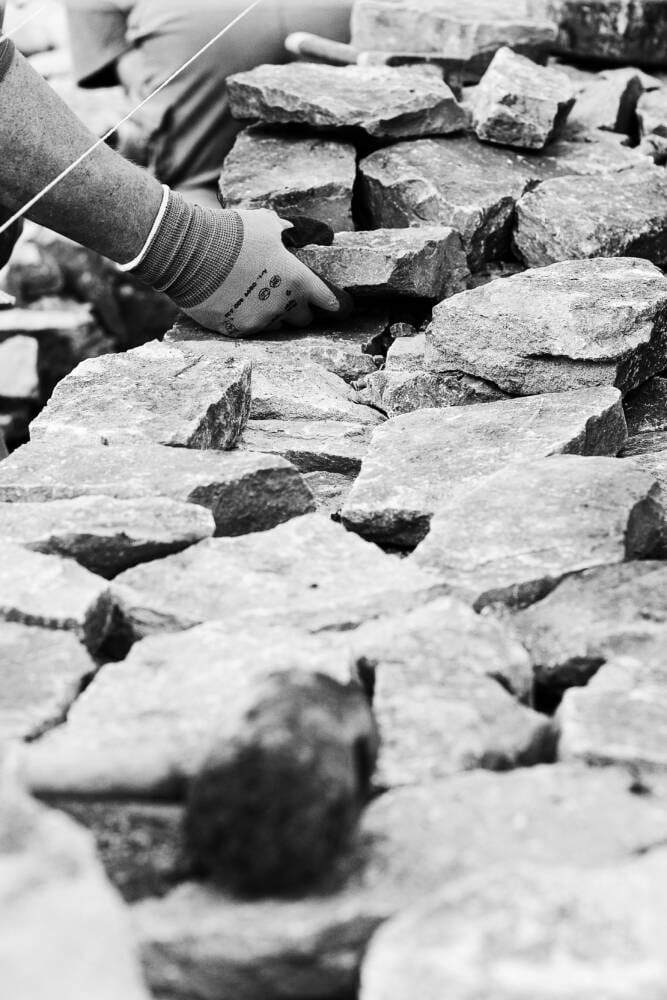
Dry stone construction was primarily a modest building technique. A dry stone structure is an assembly of stones wedged against each other to create a solid structure without the use of mortar . The lime needed for mortar is costly and requires transport, while stone is readily available. This type of masonry is typically found in rural areas.
This construction technique is reversible and has a minimal impact on the environment, as the stones can be dispersed or reused for another project. The use of local stone, and the near-total absence of machinery, tools, electrical equipment, chemicals, and pollutants, make dry stone walling an ecological technique . These traditional structures blend seamlessly into their surroundings without disrupting them. They are simply an extension of the natural environment, supporting a whole ecosystem within.
International recognition
The know-how and construction techniques in dry stone were registered on the List of intangible cultural heritage of humanity by UNESCO, on November 28, 2018, marking the culmination of several years of joint efforts between eight countries (Cyprus, Croatia, France, Greece, Italy, Slovenia and Switzerland).
This inscription is a mark of recognition of a technique representative of a harmonious relationship between human beings and nature ",who has " shaped multiple and very varied landscapes, allowing the development of different types of habitats, agriculture and livestock » and plays “ an essential role in preventing landslides, floods and avalanches, combating land erosion and desertification, improving biodiversity and creating suitable microclimatic conditions for agriculture ».
These structures bear witness to the methods and practices used by populations, from prehistory to modern times, to organize their living and working spaces by optimizing local natural and human resources . The custodians and practitioners are the rural communities, within which this element is deeply rooted, and professionals in the construction sector.
The Committee welcomed the initiative of the candidate States wishing to present a widely used technique that fully respects local conditions . It emphasized the shared cultural meanings and functions of the element in all the submitting countries. The Committee commended the candidate States for submitting an exemplary dossier , prepared with the utmost care, reflecting the spirit of the Convention at the level of international cooperation.
pillar of sustainable development
Dry stone construction is the building technique that best meets the ambitions of a sustainable and well-considered regional development project. It is the most suitable for this wine-growing landscape and represents a genuine driver of local economic development, based on shared values. The sector's growth is due to the public authorities' commitment and ambition in support of this technique and the regional development project. Here, vernacular heritage forges a link between generations and skills, offering future generations a true sense of belonging.
Dry stone construction contributes to the sustainable development policy of the Grand Site by relying on three pillars. Socially, it helps to develop a positive relationship with local residents, particularly winegrowers. It offers visitors a vibrant site with well-maintained heritage and allows for the implementation of professional integration programs.
From an environmental point of view, the restoration of dry stone walls contributes to biodiversity and agroecology.
Economically, the promotion of dry stone construction strengthens the tourism offering through its heritage value. It could be the subject of a financial aid program in the coming years, aimed at supporting restoration projects, particularly of private walls. The financial resources thus invested in the region would allow for the development of a dry stone construction industry.
Furthermore, since the name Pouilly-Fuisse obtained, in 2020, the Premier Cru classification for part of its vineyard, the Grand Site is contacted by many winegrowers wishing to rebuild their walls. These dry stone structures provide a strong identity value to wine, the main economic resource of this territory.
Dry stone is therefore at the heart of a virtuous circle that the Grand Site de France Solutré Pouilly Vergisson maintains and develops.