Inventory the heritage
To support private owners in the restoration of their walls, the Grand Site sought, in 2019, the expertise of the Council of Architecture, Urban Planning and the Environment ( CAUE ) of Saône-et-Loire to address the issue of the large landscape with a program for the regeneration of dry stone walls.
The notebooks
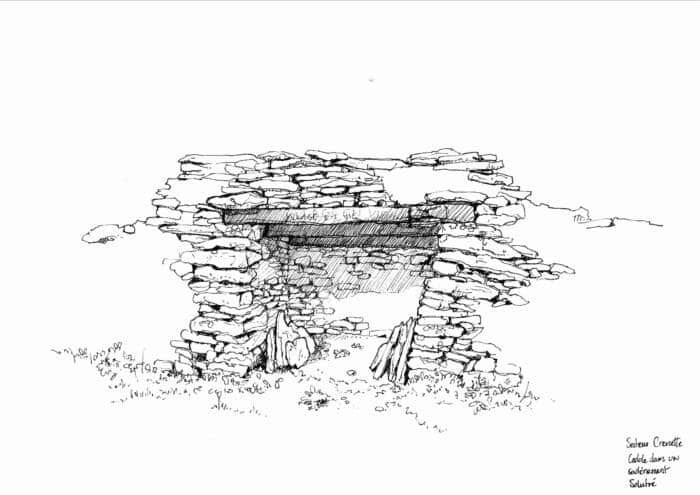
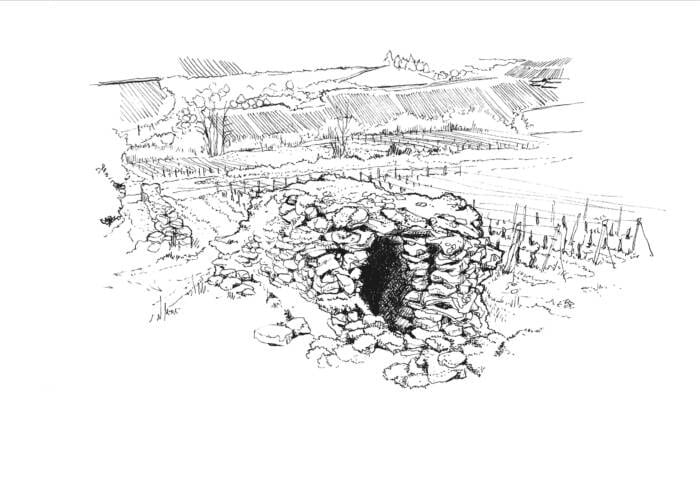
A survey of the dry stone heritage across all the municipalities, conducted from 2019 to 2021, resulted in an inventory . This survey highlighted the georeferenced layout of the network of non-removable stone structures, visible from an aerial perspective. This detailed approach allowed for an assessment of the diversity, condition, and heritage value of each structure. The inventory is complemented by a record book of the most remarkable examples, aiming to preserve the memory of these endangered buildings. Presented as informational leaflets, these leaflets raise awareness of the value and unique characteristics of these dry stone structures.
The notebooks,
municipality by municipality
cartographic atlas
reports
Un study report transcribes the entire approach and issues addressed for the redeployment of the sector. This addresses four major themes, broken down into four booklets :
• “ Understand » the origins of dry stone structures in the landscape, define and describe the typologies dry stone works.
• “ Inventory » then analyze the collected data.
• “ Undertake », draft of strategy in which levers and obstacles are identified such as resources and professional skills.
• “ Mobilize » inventory shared by all dry stone stakeholders, having brought together around a hundred people around four round tables themes: develop the sector, protect and raise awareness, restore and encourage, initiate and train.
A collaborative approach
The process of promoting and preserving this heritage begins with bringing people together to work in everyone's best interest. Organizing these roundtables in May 2021 reflects the desire to pursue a collaborative approach and move towards a practical objective. Broad participation enabled discussions around four key themes:
- "Develop the dry stone sector”. The Burgundian dry stone sector lacks labor, it is not always known and recognized, suitable local stone is sometimes difficult to find. It is necessary to ensure the presence of actors in the sector to guarantee the feasibility of restoration projects from the supply of stones to the completed work. It is also about finding a political ambition and the confidence of project owners in this technique suffering from the competitiveness of other construction systems, however unsuitable for the environment and unsustainable.
- "Protect dry stone structures and raise awareness of this heritage”. Several tools for protecting structures exist in terms of of town planning : how can elected officials take advantage of it? How to make them coherent across the territory? In addition to regulations, it is necessary to continue awareness-raising actions and experience sharing. Residents and elected officials establish bonnes pratiques and are primarily bearers of the safeguard of heritage.
- "Restore and encourage dry stone construction sites”. If some restorations are carried out respecting the dry stone technique, the works are often replaced by other constructive techniques, trivializing the landscape. Define a restoration bias ambitious et sharing is essential for supervising restorations and ensuring landscape coherence. Discussions with potential financiers focused on measures to encourage the restoration of this heritage.
- "Initiate and train in the dry stone technique". The training is also a strong axis, from initiation to specialized qualifying training. Comfort and organize thelocal offer training allows this practice to be reintegrated in Burgundy. The network of actors involved extends from project owners to project managers and craftsmen. There certification process of artisans remains an important point in the recognition of the sector and the trust placed by project owners.
The debates led to the identification of obstacles and doubts by demonstrating that the subject of dry stone can mobilize various actors, with multiple roles and interests around common values.
The discussions brought to light the obstacles and doubts that need to be addressed. These exchanges demonstrated that the topic of dry stone walls can mobilize diverse stakeholders with multiple roles and interests around shared values . The process of promoting and preserving these structures begins with bringing people together to work in everyone's best interest.